The Research Data Alliance (RDA) invites applications for its newly redesigned fellowship program. The program’s goal is to engage early career researchers in the US in Research Data Alliance (RDA), a dynamic and young global organization that seeks to eliminate the technical and social barriers to research data sharing.
The successful Fellow will engage in the RDA through a 12-18 month project under the guidance of a mentor from the RDA community. The project is carried out within the context of an RDA Working Group (WG), Interest Group (IG), or Coordination Group (i.e., Technical Advisory Board), and is expected to have mutual benefit to both Fellow and the group’s goals.
Fellows receive a stipend and travel support and must be currently employed or appointed at a US institution.
Fellows have a chance to work on real-world challenges of high importance to RDA, for instance:
The program involves one or two summer internships and travel to RDA plenaries during the duration of the fellowship (international and domestic travel). Fellows will receive a $5000 stipend for each summer of the fellowship. Fellows will be paired with a mentor from the RDA community.
- Engage with social sciences experts to study the human and organizational barriers to technology sharing
- Apply a WG product to a need in the Fellow’s discipline
- Develop plan and disseminate RDA research data sharing practices
- Develop and test adoption strategies
- Study and recommend strategies to facilitate adoption of outputs from WGs into the broader RDA membership and other organizations
- Engage with potential adopting organizations and study their practices and needs
- Develop outreach materials to disseminate information about RDA and its products
- Adapt and transfer outputs from WGs into the broader RDA membership and other organizations
Through the RDA Data Share program, fellows will participate in a cohort building orientation workshop offering training in RDA and data sciences. This workshop is held at the beginning of the fellowship. RDA Data Share program coordinators will work with Fellows and mentors to clarify roles and responsibilities at the start of the fellowship.
Criteria for selection: The Fellows engaging in the RDA Data Share program are sought from a variety of backgrounds: communications, social, natural and physical sciences, business, informatics, and computer science. The RDA Data Share program will look for a T-shaped skill set, where early signs of cross discipline competency are combined with evidence of teamwork and communication skills, and a deep competency in one discipline.
Additional criteria include: interest in and commitment to data sharing and open access; demonstrated ability to work in teams and within a limited time framework; and benefit to the applicant’s career trajectory.
Eligibility: Graduate students and postdoctoral researchers at institutions of higher education in the United States, and early career researchers at U.S.-based research institutions who graduated with a relevant master’s or PhD and are no more than three years beyond receipt of their degree. Applications from traditionally underserved populations are strongly encouraged to apply.
To apply: Interested candidates are invited to submit their resume/curriculum vitae and a 300-500 word statement that briefly describes their education, interests in data issues, and career goals to datashare-inquiry-l@list.indiana.edu. Candidates are encouraged to browse the RDA website https://rd-alliance.org/ and pages of interest and working groups to identify relevant topics and mutual interests.
Important dates:
April 16, 2015 – Fellowship applications are due
May 1, 2015 – Award notifications
June 18-19, 2015 – Fellowship begins with the orientation workshop in Bloomington, IN
RDA Data Share, funded by the Alfred P. Sloan Foundation under award G-2014-13746, engages students and early career researchers in the Research Data Alliance. This engagement builds on foundational infrastructure funded by the National Science Foundation grant # ACI-1349002.
Showing posts with label librarianship. Show all posts
Showing posts with label librarianship. Show all posts
Feb 18, 2015
Research Data Alliance/US Call for Fellows
I'm a co-PI on a project that provides a great opportunity to the early career researchers and professionals to engage with the Research Data Alliance and help to improve data practices and make data management and data sharing easier and more transparent. Below are the details from the call for fellows:

Nov 19, 2013
DLF forum notes: Data – sharing – libraries – culture
A recent Digital Library Federation (DLF) forum started with an inspiring keynote by R. D. Lankes and his challenging of the monopolies of content delivery in higher education and the neutrality of the library profession. He argued that librarians should improve society by facilitating knowledge creation, which includes not only providing access to resources, but also teaching literacy, genres, and communication, creating learning environments and motivating people to learn and research. He also emphasized that a librarian is somebody who has either training, professional experience, or spirit, thereby shifting the emphasis from degrees to actual knowledge and passion.
Of lesser success was my leading of a birds-of-a-feather session about Research Data Alliance (RDA). BoFs happened during lunch and it’s probably not a good time to learn about a new organization. Spreading the word about new initiatives is also hard because they are new and there is more anticipation and preparatory work, rather than something that is ready to use. I had several good conversations about RDA, but there could have been more.
All sessions were informative and productive, but the one that got me thinking was a session that I couldn’t attend "Creating the New Normal: Fostering a Culture of Data Sharing with Researchers". It’s a rich topic, so below is some food for thought - my interpretation of the session theme based on the materials prepared for the session by organizers and community notes taken by participants during the session.
The session was based on the Data Information Literacy (DIL) project that is looking to identify skills, capacities and toolkits for data management and leverage information literacy to bridge the disconnect between faculty, graduate students (who are often the data managers in scientific labs) and librarians.
The disconnect stems from different needs in relation to data – data collection vs analysis vs preservation and access. Even though researchers may recognize the importance of data management, they rarely consider it being part of the curriculum or articulated research culture. To simplify, graduate students collect data and both faculty and students analyze it and work on publications. The messiness of data collection and storage is something that bothers many researchers, but they don’t necessarily know what to do about it.
Librarians are increasingly interested in incorporating research data into their library collections and providing access to it as part of their service. They would like datasets to be better prepared for storage and sharing, and they are ready to help. They also have a mission of helping others to address their information needs, but they don’t necessarily have the power to do that. How could these disconnects be bridged?
By working through three scenarios proposed for discussion, the session seemed to approach disconnect bridging via embedding librarians/data specialists into research teams and projects, learning about researchers’ needs and helping them with their data, while teaching them good practices of data management. Librarians’ expertise can be useful in the areas of file organization, metadata, and tools for storage and sharing.
This approach is good, but it’s quite demanding in terms of resources. I agree that data literacy should be embedded in a larger teaching of proper information management (including ethics, security, authoritativeness, etc.) and this could help re-use existing channels of library instruction and minimize resources. At the same time, I wonder whether we should also think about the culture of data sharing in terms of private/public epistemic objects. Data is still a private object, which will constantly undermine the "new normal" of sharing, because we don’t typically share objects we consider private. The new norm then should be that data are "shareable" from the beginning.
In some organizations and domains data are already open and shareable, for example, data from the large observatories supported by the US government. Consequently, data producers in those organizations may have better data information literacy. For other "private" domains, particularly, in the social sciences, there are still a lot of barriers and fears. Would a public culture of data sharing mean peer review of data collection instruments? Survey respondents as co-owners of data? Data curators as independent decision-makers with regard to choosing and preparing data for public use? A lot of possibilities come with the idea of data sharing cultures.
Jan 9, 2013
Librarians and their skill set
CLIR blog has recently posted a piece on re-skilling for librarians by Christa Williford, focusing on digital humanities librarianship. What kind of skills do librarians need in order to be relevant in contemporary research environments? The list can be pretty long, moreover, there might be multiple lists.
Another list was proposed in a report that Christa mentioned, “Re-skilling for research” by Research Libraries UK (RLUK). The report contains results of a series of studies that aimed to map the needs of researchers onto tasks to be undertaken by subject librarians.
The report is long, but the message is the same over and over: librarians’ roles and skills are quite limited and traditional; they do not match the needs. Subject librarians are not involved at the early stages of research that involve conceptualization and planning. Most of the services are still offered in the areas of literature search and information management (how to store and organize everything). Services that are related to data collection, management, analysis and preservation are in their infancy at best.
The list of 32 skills in this report includes:
- deep knowledge of the discipline/subject
- understanding of research experiences and workflows
- knowledge of funding sources and mandates of funding agencies
- knowledge of storage and information management techniques
- knowledge of data sources and data manipulation techniques and good familiarity with metadata and emerging technologies
While all those skill suggestions sound reasonable, I’m not sure that it’s realistic for librarians to sustain such a huge change. The skill sets described above require completely different training. Once a person goes through such training, librarianship might not be the most fulfilling career path for them. Perhaps, re-skilling in librarianship should happen not in the areas of actual skills and knowledge sets, but in the orientation of library services - from offering advise and consultation to enabling various forms of scholarly activities. As enablers, librarians are providers of spaces, infrastructure, resources, tools, etc. that facilitate preservation and dissemination of knowledge. In this case it's not about their skills per se, it's about finding the right partners and promoting the right cause.
Mar 31, 2011
Russian Posters Collection, 1919-1989, at Duke University Libraries
A new digital collection at Duke University libraries called the "Russian Posters Collection, 1919-1989". Some of them can be understood without words, a lot of them require knowledge of Russian for full appreciation.
Like this one:
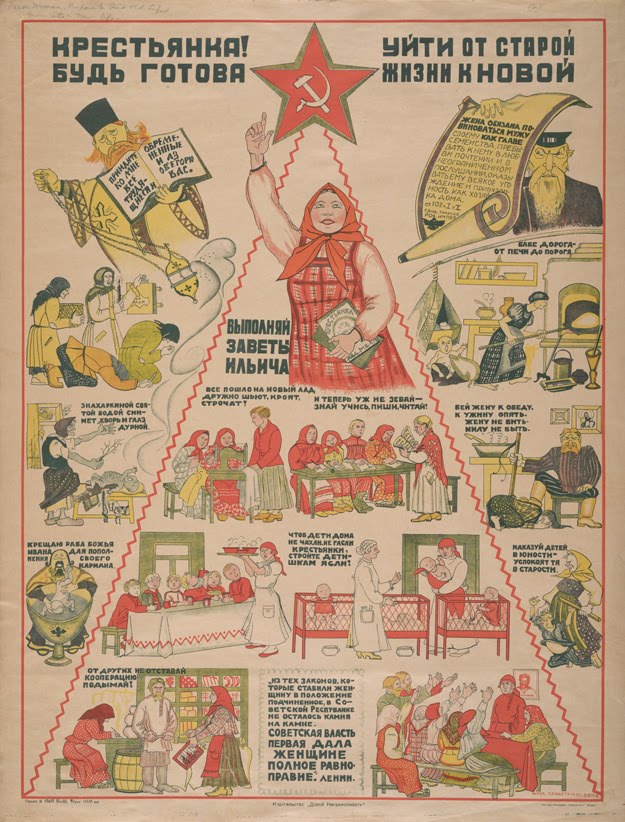 |
| Крестьянка! Будь готова уйти от старой жизни к новой (rpcps01002) - Peasant woman! Be ready to start a new life. |
On the sides, where the poster pictures the old lifestyle, it says: "Treat illness and evil eye with holy water", "Beat your wife, or you won't be dear to her", "Punish your children and they will help you when you're old", "Woman's path is from stove to threshold". In the middle where the pictures of new lifestyle say: "Follow Lenin's precepts", "Work and learn to read and write", "To make your children happy and healthy, put them into daycare". And my favorite - "Soviet rule is the first rule that gave women full equality". I guess now under new post-Soviet capitalist rule of the 90s and 00s we lost it again...
Sep 23, 2009
Web 2.0 and librarians
From On the Boundaries of Reference Services: Questioning and Library 2.0 , Journal of Education for Library and Information Science, 50(3), p. 164-175 (by subscription):
Goal: To understand the demand for "Library 2.0" skills in librarianship as well as evaluate the attitudes of students toward 2.0 technologies
Method: surveys of library staff in 242 public libraries about technology, observations of libraries websites, surveys of students in two universities - 31 graduates taking a course in reference and 46 undergraduates taking courses from Informatics dept.
Results:
Goal: To understand the demand for "Library 2.0" skills in librarianship as well as evaluate the attitudes of students toward 2.0 technologies
Method: surveys of library staff in 242 public libraries about technology, observations of libraries websites, surveys of students in two universities - 31 graduates taking a course in reference and 46 undergraduates taking courses from Informatics dept.
Results:
- Libraries implement technologies (153 libraries had blogs, 105 participated in social networking sites, 91 libraries used wiki, RSS, Flickr, YouTube and Delicious was also used)
- Use of Web 2.0 by students (an excerpt):
Web 2.0 type
Undergraduates
Graduates
MySpace
80.4%
29.4%
Facebook
84.8%
2.9%
Wikis
95.7%
5.9%
Blogs
47.8%
17.6%
- Students didn't think that it was appropriate to ask librarians about blogs and social networking sites.
- LIS graduate students didn't think Web 2.0 was relevant to librarianship
"It never would have occurred to me to as a librarian with help [sic] finding one of these websites."
"We need to train librarians and build into job descriptions technological proficiencies. You work with books but also the Web."
"web 2.0 services currently are not really helpful in an academic setting so I assume librarians have better things to do."
"Older librarians might not have this knowledge."
Subscribe to:
Posts (Atom)