Showing posts with label communication. Show all posts

Jul 7, 2015

Climategate study - simpler methods into the mix

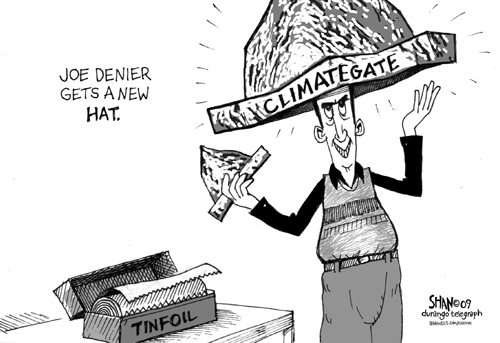
Joe Denier gets a new "climategate" hat
Image from a HuffPo article by Shan Wells

Climategate was a controversy unfolded in November 2009 after thousands of emails and files from the Climatic Research Unit (CRU) at the University of East Anglia (UEA) were published online without the owners' consent. The climate change opponents used the content of the emails to argue that scientists manipulated data to prove their argument for human responsibility of climate change. Several investigations didn't find any scientific misconduct at the CRU, but the reports called for opening up access to research data and more transparency in methods and communication of results (see Climactic Research Unit email controversy in Wikipedia).


Controversies are always hard to sort through, but they present an interesting research case for those like me who are interested in discourse, language, and media. A recent study "The creation of the climategate hype in blogs and newspapers: mixed methods approach" (paywalled) looked at the Climategate controversy and compared discussions in blogs and newspapers.

Newspaper and blog data were collected from the LexisNexis Academic database using the search term ‘climategate’. Two methods were used to analyze the data: a) ARIMA (Auto Regressive Integrated Moving Average) modeling to create a model of the daily frequencies of postings and to examine the mutual influence of newspapers and blogs and b) semantic co-word maps of blogs and newspaper headlines to compare framings of climategate.

The results of the modeling seemed a bit confusing as they showed a significant link between a high number of blogs and a high change in newspapers articles (either increase or decrease) on the same day. (I'd really like to see simple descriptive statistics of posts per day, etc. Also, a pre-print where all the images and tables are at the end of the article is very hard to read). At the same time an increase in newspaper articles on one day had no effect on the number of blog postings on the next day. The conclusion of the article is that blogs influenced newspapers, but not the other way around. The semantic maps showed (predictably) that the blogs used a more informal language and framed the topics more negatively, while the newspapers were more formal and stayed more neutral. Both blogs and newspapers picked up similar sub-topics, such as climate change, scientists, and so on, although the word "climategate" occurred more in blogs.

Several thoughts / questions upon reading this interesting, although a bit too methodologically complicated for such simple variables and questions, study:

  • How different are "traditional" and "new" media nowadays? They may be still different in their language style, but what about the speed of publication, audiences, contributors, and so on? The headlines don't get to the differences in main posts and comments either.
  • The word "climagate" did originate in a blog, but it was a journalist who picked it up and popularized it via a newspaper-hosted blog (see Climategate: how the 'greatest scientific scandal of our generation' got its name). Does it change the conclusion that "blogs were independent of the attention in newspapers" (p. 20) if journalists write for both media?
  • It would've been helpful to establish the actual sequence of events via an additional documentary analysis. The paper argues that the word "climategate" originated in blogs, which promoted the hype. But according to the Wikipedia article, news about emails release were published almost simultaneously in blogs and newspapers - on November 20, 2009. So is the hype about the word or other, more nuanced exchanges and actions as well?
  • Three blogs received links to leaked documents. It seems that it was intentional - the blogs were skeptical of climate change. Did it matter for how the hype have originated and developed? Again, what is the connection between the actual controversy and its naming as climategate?
  • How can the link between the large number of blog posts and the decrease in newspapers articles be explained? More quotes and examples of interactions and influences between blogs and newspapers could be very helpful in illustrating all the findings.

Overall, it seems that the studies of controversies benefit from careful tracings of words and actor connections rather than from complicated modeling that is rather confusing and not so eye-opening.

Sep 23, 2014

Summer school on synthetic biology

During the week of September 15-19, 2014 I participated in the summer school on societal implications of synthetic biology. Organized by Kristin Hagen and Margret Engelhard from the European Academy of Technology and Innovation Assessment and by Georg Toepfer from the Center for Literary and Cultural Research Berlin, it was held in Berlin, Germany, at the Center for Literary and Cultural Research.

Participants came from different countries - Austria, Italy, Germany, the Netherlands, Canada and the United States. Similarly, their backgrounds were quite diverse - biology, chemistry, philosophy, sociology, political science, and communications. The main goal of the school was to have an interdisciplinary discussion about synthetic biology as an emerging area of science and its implications for society. Participants wrote papers and presented them at the school. Additionally, several experts from various fields gave their talks. Below is a short summary of what we talked about:

The meanings and metaphors of life. Synthetic biology inevitably raises questions related to our understandings of life. On one hand, there is no universal definition of life and both philosophers and scientists continue to ponder over whether it is even possible to come up with such a definition. On the other hand, there may be no need for such definition, because a) we have an intuitive understanding of what life is and adapt as it changes, and b) having limited definitions works for specific purposes, such as understanding of how to create an artificial cell or argue against the scientific possibility of creating life from scratch. Metaphors that we use to answer the grand questions of life or to promote scientific advancements in synthetic biology bring together the domains of nature, artificiality, control, and aesthetics. Those metaphors are not “innocent” as they open some opportunities and close others.

Synthetic biology (SB) as a field. Synthetic biology is not a homogeneous discipline, it is a fuse of approaches that draw on synthetic chemistry, genetic engineering, and bioinformatics. The engineering of metabolic pathways, which allows to use bacteria and other microorganisms to produce chemicals, plays an important role in SB breakthroughs. Chemical synthesis of DNA, which allows a synthesized DNA to be inserted into an existing organism, is another important area of synthetic biology. The presentations that explained various types and flavors of synthetic biology talked about cells, pathways, chassis, microbes, reproduction, and evolution; they were colorful and full of exciting possibilities. We talked about promises of synthetic biology a lot, but I don’t think that science necessarily needs promises to justify its existence. As someone pointed out, science is a quest for knowledge, it should be interesting and exciting as such. I’m not sure science is a pure quest for knowledge, considering the convergences between science, technology, and industry. Nevertheless, I completely agree that it is exciting to learn about the world even if it's not clear whether this knowledge has applications.

Forms of communication and public dialog. Previous debates, such as the mad cow disease or GMO debate, and the resulting negative reactions demonstrate the importance of transparency in public communication of science. Early public engagement is seen as a way to improve understanding and acceptance of technology. On the other hand, the goal is not simply to promote public understanding and acceptance of technoscience, but rather to let voices of the public contribute to decision-making and regulatory frameworks. Many forms of public engagement, including polls, surveys, citizen panels, public discussions, and so on, have been promoted in the EU, and the results seem to indicate that even though not many people have heard about synthetic biology, many see continuities with previous scientific advancements and technologies and are willing to consider both positive and negative aspects of it.

Even from the short overview above it is obvious that there is a great diversity in the issues surrounding synthetic biology and approaches to their evaluation. Can they be integrated or synthesized? My own suggestion is to take a problem- rather than a debate-oriented approach and look for solutions to specific problems, while avoiding taking things for granted. Everyone has their interests and values and even the best intentions may result in bad outcomes. To use M. Foucault’s approach, we need to examine the order of things and the complex arrangements of what’s visible and hidden and what or who is included and excluded.

It was a week of stimulating discussions. The atmosphere was very friendly and collegial, and the disagreements were often phrased as humorous, slightly sarcastic remarks over dinner or drinks. My take-away from this summer school is that interdisciplinary dialog is possible, necessary, and fruitful. It works provided that we have ample time to interact and go beyond formalities (i.e., beyond formal presentations and opinion polls). The school has ended, but the work continues. We will revise our papers based on collective feedback, and they will become chapters in a forthcoming book.

See also:

Apr 27, 2010

Published in Journal of Documentation

My article "Information about the synthesis of life forms: a document-oriented approach" is finally published in the Journal of Documentation (url). It takes almost a year for an accepted article to be published. How come in the age of practically instant communication scholars are still ok with that?

Apr 8, 2010

Minimal effects and modern communication

A paper by W. Lance Bennett and Shanto Iyengar "A new era of minimal effects? The changing foundations of political communication" (pdf) in the Journal of Communication (2008, 58, 707-731) raises the following question: assuming that people are more detached from social institutions that used to provide shared interpretative context and that information channels proliferated and became more individualized, can we say that media effects on people's opinions are minimized and dependent on a largely unknown set of factors?

From p. 708:

As receivers exercise greater choice over both the content of messages and media sources, effects become increasingly difficult to produce and measure in the aggregate while creating new challenges for theory and research.

The authors bring together several strands of research from sociology, political science, and communication to talk about current theoretical debates in the field of political communication and argue for the need to theorize sociotechnical changes that affect modern communication. These sociotechnical changes include selectivity in media source choices, fragmentation of content, and polarization of consumption (seeking sources congruent with one's attitudes and predispositions).

Essentially, this need for theories is framed as a choice between two communication theories - agenda setting theory (media have a large influence on audiences) and the theory of minimal effects (media messages marginally influence the public). To me it seems that the issue is more complex than either of this theories stipulates. But I like the paper's concluding suggestion (along with a set of questions):

Many other areas may benefit from interrupting the pursuit of normal science and thinking about larger democratic implications of a fragmented media environment populated by vastly different audience segments. How do we think about the growing numbers who elude the best efforts to bring them into political debates that do not interest them as much as reality TV, yet who remain critical to election outcomes or legitimation of wars? How shall we think about the solid blocs of 30 or so percent on each end of the spectrum who are actively engaged yet prove unresponsive to most efforts to impart new information, to stimulate deliberative activities, or to deepen concerns about others in society (e.g, the lack of popular engagement with issues such as inequality)? In addition, how can we add ideas about how to involve younger citizens in the interactive life of democracy in ways that enable them to become producers of information rather than just passive consumers of non-credible advertising?

My thinking - more efforts into matching the multiplicity of sources of information with multiplicity of producers, languages, and messages. So far it seems that the hierarchical model of information production and dissemination is slow to change.

Apr 22, 2009

L.A. Lievrouw: New media, mediation, and communication study

A nice review of concepts and theories in communication studies: Lievrouw, L. A. (2009). New media, mediation, and communication study. Information, Communication & Society, 12(3), 303.

The article identifies three conceptual moments that define the development of communication studies: theories of media effect that focused on mass communication, concepts of "new media" and mediation, and cultural studies of the uses of ICTs. The trajectory in the development of communication studies is towards convergence.The first conceptual moment is characterized by the focus on media effects and impacts.


Lazarsfeld and Katz proposed the two-step flow process of "media to conversation to opinion" as a critical response to linear models of communication that defined communication as transmission (sender-message-channel-receiver). This opened the way for other mass communication theories that viewed audiences and media as enmeshed in complex interpersonal relations.
Subsequent research followed two directions corresponding to main "intervening variables" involved in two-step flow: decision studies (opinion formation, voting decisions, etc) and diffusion studies.

In decision studies there uses and gratifications theory, expectancy value theory, dependency theory, and reader-response theory. Uses and gratifications theory argues that users make rational choices among media and messages according to their personal needs and interests. Refinements such as expectancy-value theory and dependency theory addressed the overemphasis on audience's rationality and goal-directedness. Reader-response theory is used to study audience reception to media.


Diffusion studies use diffusion of innovations theory (the communication and adoption of new practices through social systems). Diffusion framework focuses on how people share information, adopt technologies and products, etc. It has been criticized for technological determinism and for the tendency to view innovations positively, thus to privilege the interests of their promoters.

The second moment focused on the attempts to incorporate new media in communication studies. One approach was to adapt existing communication theories to the study of new systems. Another - to draw on a mix of methods and concepts from other disciplines.

From science and technology studies the following was adopted: the concept of the mutual-shaping of society and technology as well as ethnographic and ethnomethodological approaches. Computer-mediated communication framework is another strategy that allowed to study interpersonal interactions via computer-based networks. Some analysts began to reconsider the assumptions that f2f interaction is the richest form of interaction and that the introduction of technology degrades the quality. One conceptual move was to frame interaction in terms of 'presence', i.e., the variety and perceived quality of communication afforded by media. Other theories and concepts: media richness theory, social context cues, interactivity (the extent to which media and information technologies foster a sense of reciprocity, mutuality, feedback, etc.)

The third moment reflects the cultural turn to humanistic approaches from cultural/critical studies. Media are viewed as instruments in the reproduction and transmission of dominant ideologies, interests, and power structures. The drawback is that the cultural-transmission approach views new forms of technologies as new mass media, which may ignore their interactive and participatory features. This view began to shift over the last decade. The concept of connected presence describes non-mass flows of information via mobile phones, email, SMS, and chat. Domestication theory (people consume and appropriate new media, which influences subsequent technology development) is a response to the ideas of mutual shaping. Mediation is the concept that can help to bring together multiple strands of communication studies and bridge the gap between studies of mass media and studies of interpersonal communication.

To conclude, the article argues that "any satisfactory theory of communication today must account for its dual social and technical nature, and for the experience of communication as a seamless and continually negotiated web of meaning, practices, tools, resources, and relations. ... we should keep in mind the multilayered meanings of the word mediation itself - both the technological means or forms of expression, and the interpersonal processes of moderation, negotiation, and intervention." (p. 317).