Showing posts with label digital media. Show all posts

Jul 7, 2015

Climategate study - simpler methods into the mix

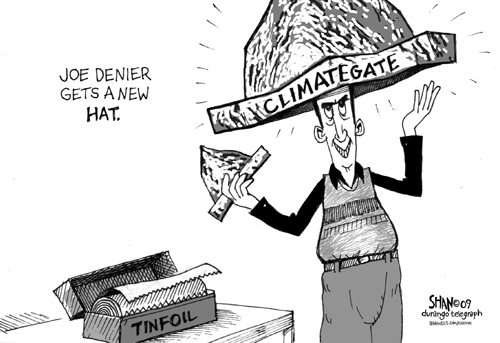
Joe Denier gets a new "climategate" hat
Image from a HuffPo article by Shan Wells

Climategate was a controversy unfolded in November 2009 after thousands of emails and files from the Climatic Research Unit (CRU) at the University of East Anglia (UEA) were published online without the owners' consent. The climate change opponents used the content of the emails to argue that scientists manipulated data to prove their argument for human responsibility of climate change. Several investigations didn't find any scientific misconduct at the CRU, but the reports called for opening up access to research data and more transparency in methods and communication of results (see Climactic Research Unit email controversy in Wikipedia).


Controversies are always hard to sort through, but they present an interesting research case for those like me who are interested in discourse, language, and media. A recent study "The creation of the climategate hype in blogs and newspapers: mixed methods approach" (paywalled) looked at the Climategate controversy and compared discussions in blogs and newspapers.

Newspaper and blog data were collected from the LexisNexis Academic database using the search term ‘climategate’. Two methods were used to analyze the data: a) ARIMA (Auto Regressive Integrated Moving Average) modeling to create a model of the daily frequencies of postings and to examine the mutual influence of newspapers and blogs and b) semantic co-word maps of blogs and newspaper headlines to compare framings of climategate.

The results of the modeling seemed a bit confusing as they showed a significant link between a high number of blogs and a high change in newspapers articles (either increase or decrease) on the same day. (I'd really like to see simple descriptive statistics of posts per day, etc. Also, a pre-print where all the images and tables are at the end of the article is very hard to read). At the same time an increase in newspaper articles on one day had no effect on the number of blog postings on the next day. The conclusion of the article is that blogs influenced newspapers, but not the other way around. The semantic maps showed (predictably) that the blogs used a more informal language and framed the topics more negatively, while the newspapers were more formal and stayed more neutral. Both blogs and newspapers picked up similar sub-topics, such as climate change, scientists, and so on, although the word "climategate" occurred more in blogs.

Several thoughts / questions upon reading this interesting, although a bit too methodologically complicated for such simple variables and questions, study:

  • How different are "traditional" and "new" media nowadays? They may be still different in their language style, but what about the speed of publication, audiences, contributors, and so on? The headlines don't get to the differences in main posts and comments either.
  • The word "climagate" did originate in a blog, but it was a journalist who picked it up and popularized it via a newspaper-hosted blog (see Climategate: how the 'greatest scientific scandal of our generation' got its name). Does it change the conclusion that "blogs were independent of the attention in newspapers" (p. 20) if journalists write for both media?
  • It would've been helpful to establish the actual sequence of events via an additional documentary analysis. The paper argues that the word "climategate" originated in blogs, which promoted the hype. But according to the Wikipedia article, news about emails release were published almost simultaneously in blogs and newspapers - on November 20, 2009. So is the hype about the word or other, more nuanced exchanges and actions as well?
  • Three blogs received links to leaked documents. It seems that it was intentional - the blogs were skeptical of climate change. Did it matter for how the hype have originated and developed? Again, what is the connection between the actual controversy and its naming as climategate?
  • How can the link between the large number of blog posts and the decrease in newspapers articles be explained? More quotes and examples of interactions and influences between blogs and newspapers could be very helpful in illustrating all the findings.

Overall, it seems that the studies of controversies benefit from careful tracings of words and actor connections rather than from complicated modeling that is rather confusing and not so eye-opening.

Aug 21, 2012

Education via networks and discourse

A must read by Ron Day: "Network mediated discursive education: From computational to networked knowledge in the university", The Information Society, 28:4, 228-235 (doi). The article is an inspiring call for change and empowerment in universities. It argues that students and faculty can and should make universities centers of democratic education that drives social change for the better:

In the modern period, universities were created to be central agents in fostering not just industry, but progressive social change through scientific and critical research. This modern mandate for universities should be renewed and vastly expanded with the help of new information and communication devices, but this can only come about by a total educational commitment to democratic empowerment and the transformation of the current university formation.

Productive knowledge as the knowledge produced by sciences and increasingly social sciences and humanities is insufficient for political change and empowerment. Networked knowledge understood as computational expansion of the productive knowledge is not enough either. It assumes the existing norms and carries empirical investigations according to them. We need critical knowledge, which traditionally was advanced by humanities, as the product of examining and questioning meanings and norms.

In short, critical knowledge is information plus judgment (I'd say "reflection"). It is when in addition to learning concepts and facts, one also learns the conditions of knowing as well as forms and norms of cultural reproduction. This type of knowledge requires the internal and comparative analyses, it aims toward understanding the disjunctions between what is said and what is going in reality (both historical and modern).

Universities today become subsumed within the logic of capitalist production. Education and research become vehicles for generating revenue and decreasing costs. A critical discourse dedicated to a fundamental critique of that production gets left out. As a consequence, we are faced with the failure of the faculty as a whole to educate students for understanding and evaluating current events (e.g., in the economy and politics); increasing corporate and government control over research; the failure of the university to empower the lives and intellect of its communities because they use an army of part-time, non-tenured and non-tenure-track, employees.

Overcoming those woes is a very difficult task. But if we emphasize a need for change, we could leverage productive and critical knowledge together as well as sociotechnical networks and reach a balance between the logics of capital and social justice. Ron proposes a model of “network mediated discursive education” as a model that is better suited for this (the model probably needs a better name).

Some recommendations toward that model include:

  • Distributed expertise. Education should rely on the expertise that is distributed across institutions, communities, regions, countries, and technologies.
  • Strong general education for all and apprenticeship for professionals. Professionals should be taught in apprenticeship programs, not in universities' graduate schools. Universities can augment professional training by showing the possibilities for institutional change, based on research and analysis.
  • The Enlightenment mandate. Rather than being a vehicle for capitalism (revenue-oriented innovation and entrepreneurship), universities must focus on education in understanding and taking hold of social and political power.

Most of it is easier said than done. But becoming aware of the issues raised in this article is a good start.

Apr 12, 2012

Websites as cultural expressions

Possibly quite useful article by Luc Pauwels "A Multimodal Framework for Analyzing Websites as Cultural Expressions" (Journal of Computer-Mediated Communication, 17 (2012) 247–265, link).

The article describes a tool for analyzing websites as both media and sociocultural phenomena. It offers guidance for descriptive and interpretative approaches to analysis.

Below is a concise version of the multimodal framework:

  1. First impressions and reactions: “look and feel”, affective reactions
  2. Salient features and topics: website features and attributes, present and absent content categories and topics
  3. In-depth analysis of content and formal choices
    • intra-modal analysis (typographic signifiers, layout, visual representations
    • cross-modal analysis – image/text, typography/text relations, sound/image relations, design/language/video/audio interplay
    • in-depth “negative” analysis (what’s missing)
  4. Embedded points of view or “voice” and implied audiences and purposes
  5. Information organization – structural and navigational options and constraints, gate keeping tools, external hyperlinks, directed and interactive features
  6. Contextual analysis, provenance and interference – senders and sources, technological platforms, attribution of cultural hybridity

Sep 27, 2011

Libraries vs authors - not again

This article "Authors Take Libraries to Court in Face Off on Copyright Issues" came up in my news feed today. The Authors Guild, some other organizations and 8 authors filed a suit against HathiTrust and several universities (including my own Indiana University and its libraries), blaming them for the "systematic, concerted, widespread and unauthorized reproduction and distribution of millions of copyrighted books and other works." (text of their complaint).

Really? Do these organizations and individuals have legitimate concerns regarding the dissemination of their work or are they there for publicity and settlement money? It seems that if they had legitimate concerns, they would've done it differently. Why attack libraries, which don't really profit from all their work but rather try to provide better and more adequate services to their populations? Isn't it an attempt to go for smaller fish in order to get bigger fish? Libraries have an agreement with google, so this suit looks more like a move against google. If Google steps in, it can settle a better deal for everybody.

Getting one's name out isn't a bad idea either. For example, the article about the suit mentions Frances Grimble, who quoted as saying "It is time for libraries to go. Clearly, their only goal these days is to maintain their existence—with the aid of public funding, which most writers and publishers do not get—in a world where libraries have become obsolete." Hm... The argument doesn't seem to have much evidence to support itself. I talk about library obsolescence with my students all the time and we always come back to "but what do you mean by 'library'?".

It seems that Ms. Grimble's understanding of libraries needs to be updated. Libraries provide access to the internet, databases, digital books, ipods, ipads, e-textbooks, etc., etc. And they rely on public funding, because their goals are not to earn money (which is the goal of authors and publishers), but to preserve knowledge and disseminate it among those who can't afford to pay $35 for a book (the average price of most Ms. Grimble's books on amazon). Public funding allows citizens to combine financial resources (through taxation, etc.) and create a pool of shared resources so that the larger group can benefit from it. Modern resources are digital resources. It's obvious that libraries should provide access to digital resources. Why anybody would want to fight it unless they have an ulterior motive? I certainly wouldn't want to buy every book or DVD I use. I don't have that much money and honestly, most of it is not even worth it.

HathiTrust Statement on Authors Guild, Inc. et al. v. HathiTrust et al.

Jan 6, 2011

Paper: Technical capital

Zhang, W. (2010). Technical capital and participatory inequality in eDeliberation: An actor-network analysis. Information, Communication & Society, 13(7), 1019-1039.

Intro: Capital is a set of usable resources and powers that function in fields. Bourdieu discussed economic, cultural, symbolic and social capitals, which can transform into one another and from one field to another. This paper argues that with the incorporation of ICTs into the field of politics, technical capital should be added as a form of capital as well.

Technical capital is a structural (i.e., independent of the consciousness and will of agents and constitutive of fields) relation between technologies and other actors. Accumulation of technical capital happens through the establishment and maintenance of the relations with technologies.

Data: surveys from two cases - the Electronic Dialogue 2000 and the Healthcare Dialogue projects. Both projects consisted of groups of citizens who engaged in a series of moderated chats about 2000 US presidential campaign and about the country's healthcare reform.

Analysis: Mean comparisons, OLS regressions, qualitative content analysis of open-ended questions.

Results: SES variables (education, age, income, gender) have impact on participation. Inventory of actors includes funders, designers, moderators, participants, internet, chatroom, time. Inventory of capitals included economic, social, cultural, symbolic, technical. Technical capital contributed to inequalities according to the surveys. E.g., people were unable to access a computer, had technical failures, had no means to repair their computers, etc.
Conclusion: Disadvantaged groups have more difficulties in establishing and maintaining a relationship with the technologies. They are also less successful in converting other capitals into the technical capital in need.

My opinion: The idea of technical capital is interesting and theoretically fruitful. Some ANT ideas also seem to be interesting, but they were not elaborated in the paper. The empirical part is rather obvious, but still important considering the enthusiasm regarding participatory potential of digital media.

Nov 12, 2010

Digital genres

The paper "Digital genres: a challenge to traditional genre theory" by Askehave and Nielsen (2005, vol. 18, N 2, Information Technology and People) argues that the Swalesian genre theory must be revisited to incorporate medium into it. According to Swales, genres are characterized by three components: communicative purpose, move structure, and rhetorical strategies.

The authors argue that media properties, specifically multi-medianess (text, sound, animations) and hypertext/hyper-reading (non-linear content and reading patterns facilitated by links), must become part of the model. They examine homepage as a new web-mediated genre. The revised genre model includes two modes, reading and navigation. In the reading mode, the text must be characterized in terms of communicative purpose, moves, and rhetorical strategies. In the navigating mode, the medium must be characterized in terms of its communicative purpose, links, and rhetorical strategies.

While I agree that medium is an important characteristic that influences text production and communication, I think it was important before the web as well. Whether a text is printed (as a book or an article) or recorded (using analog devices), it will affect its content, perception, and use. And print media also have a navigation mode (table of content, page numbers, indexes, cross-references, etc.). So what is different? Something is different, since we didn't pay much attention to the medium before or considered it to be a transparent element of the genre. Perhaps, it's speed, immediacy, increased quantities of information, etc. brought by digital media that affect text production and consumption in digital genres.

Apr 8, 2010

Minimal effects and modern communication

A paper by W. Lance Bennett and Shanto Iyengar "A new era of minimal effects? The changing foundations of political communication" (pdf) in the Journal of Communication (2008, 58, 707-731) raises the following question: assuming that people are more detached from social institutions that used to provide shared interpretative context and that information channels proliferated and became more individualized, can we say that media effects on people's opinions are minimized and dependent on a largely unknown set of factors?

From p. 708:

As receivers exercise greater choice over both the content of messages and media sources, effects become increasingly difficult to produce and measure in the aggregate while creating new challenges for theory and research.

The authors bring together several strands of research from sociology, political science, and communication to talk about current theoretical debates in the field of political communication and argue for the need to theorize sociotechnical changes that affect modern communication. These sociotechnical changes include selectivity in media source choices, fragmentation of content, and polarization of consumption (seeking sources congruent with one's attitudes and predispositions).

Essentially, this need for theories is framed as a choice between two communication theories - agenda setting theory (media have a large influence on audiences) and the theory of minimal effects (media messages marginally influence the public). To me it seems that the issue is more complex than either of this theories stipulates. But I like the paper's concluding suggestion (along with a set of questions):

Many other areas may benefit from interrupting the pursuit of normal science and thinking about larger democratic implications of a fragmented media environment populated by vastly different audience segments. How do we think about the growing numbers who elude the best efforts to bring them into political debates that do not interest them as much as reality TV, yet who remain critical to election outcomes or legitimation of wars? How shall we think about the solid blocs of 30 or so percent on each end of the spectrum who are actively engaged yet prove unresponsive to most efforts to impart new information, to stimulate deliberative activities, or to deepen concerns about others in society (e.g, the lack of popular engagement with issues such as inequality)? In addition, how can we add ideas about how to involve younger citizens in the interactive life of democracy in ways that enable them to become producers of information rather than just passive consumers of non-credible advertising?

My thinking - more efforts into matching the multiplicity of sources of information with multiplicity of producers, languages, and messages. So far it seems that the hierarchical model of information production and dissemination is slow to change.

Nov 2, 2009

Paper: Innovation and knowledge in the digital media sector

An article in the new issue of Information, Communication and Society (Vol. 12, N 7, 2009) - Innovation and knowledge in the digital media sector (pp. 994 - 1014, by subscription).

The article has some interesting terminology, but no particularly interesting claims or findings. It distinguishes between the terms "creative industry", "digital content industry", and "cultural industry" and proposes to rely on the latter, the cultural industries, and incorporate it into the concepts of information economy and the primary information sector (PIS). This should help to avoid "terminological clutter" in understanding of the media services and their innovation processes. PIS includes all industries that produce information machines, goods, and services to sell in the market place.

The discussion of some case studies allows the authors to come to a conclusion that four knowledge domains provide inputs to innovations:

  1. Technical knowledge.
  2. Knowledge related to digital media authoring, design, and production.
  3. Knowledge about specific businesses, policies, and regulations.
  4. Knowledge of the organizational and industrial culture of the media sector.
What's new? Arguments about the complexity and multiplicity of types of knowledge involved in media development and innovation have been made before. How does it help us to understand what is going on in the digital media sector? And how is it different from other sectors of economy?