Showing posts with label review. Show all posts

Jun 14, 2016

Mapping scientific fields, domains and specialties

I'm embarking on a new project that focuses on mapping research fields and studying the evolution of certain concepts and research communities. I have a certain field in mind that I'd like to investigate, but first I need to learn more about scientometrics and mapping of research domains. This is a first in the series of notes from my readings - a review chapter in the Annual Review of Information Science & Technology (ARIST) titled "Mapping Research Specialties"".

The chapter defines research specialty as a self-organizing network of researchers that tends to study the same research topics, attend the same conferences, publish in the same journals, and also read and cite each others’ research papers.

Other definitions of research specialties:

  • Kuhn (1970) - communities of one hundred members, sometimes less 
  • Price (1986) - an “invisible college” of approximately 100 “core” scientists, monitoring the work of individuals who are rivals and peers by reading about 100 papers for every one published
  • Lievrouw (1990) - a set of informal communication relations among scholars or researchers who share a specific common interest or goal 
  • Small (1980) - consensual structure of concepts in a field, employed through its citation and co-citation network 
  • Rogers, Dearing, and Bregman (1993) - a family tree in which earlier studies influence later studies
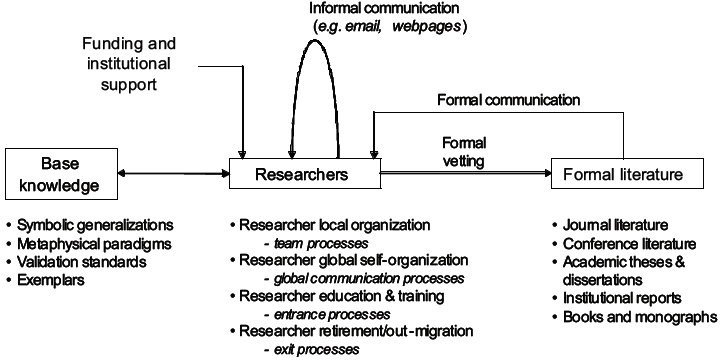
The term "specialties" rather than invisible college allows to avoid the assumption that the researchers are in frequent informal communication.

research specialty model
Fig. 6.2 from "Mapping research specialties"
Research specialties are therefore an interconnected group of researchers that has their own knowledge base with its own concepts, paradigms and validation standards, and uses particular channels of formal and informal communication.


Studies of research specialties are connected to the key questions raised by Chubin in his 1976 review of the field "The Conceptualization of Scientific Specialties":
  1. What are the social and intellectual properties of a specialty? 
  2. How do specialties grow, stabilize, and decline? 
  3. What are the temporal and spatial dimensions of a specialty? 
  4. How do specialties vary in size, scope, and life expectancy? 
  5. What are the institutional arrangements that support specialties? 
  6. What impact does funding have on the kind and volume of research produced in a specialty?
  7. What kinds of communication relations sustain research activities in a specialty? 
The following approaches are used in the studies of research specialties:

  1. The sociological approach (seems to be much more developed than others): science as an institution (Merton); science as a system of beliefs (Bloor, Barnes, Collins); science as culture (Latour, Woolgar, Knorr-Cetina); science as collaboration and competition (Whitley, Gibbons); science as boundary making and demarcation (Gieryn)
  2. Bibliographic or bibliometric: relevance (topics, novelty, availability, etc.); citations and co-citations; author co-citations; co-word analysis
  3. Communicative approach: knowledge diffusion through informal channels and discourses and rhetoric in science 
  4. Cognitive approach: paradigm shift (Kuhn) and branching of ideas (Mulkay)

Mapping research specialties helps to find the structure and dynamics of a research specialty and can include:

  1. A map of the network of researchers and research teams involved with the specialty.
  2. A map of the base knowledge supporting research in the specialty.
  3. A map of current research topics in the specialty.
 A map of a specialty is a representation of the structure and interconnection of known elements of the specialty, which includes research topics, teams, concepts, authorities, archival journals, research institutions, and technical vocabularies. Mapping techniques often include bibliometric methods, such as reference co-citation analysis, bibliographic coupling analysis, co-authorship analysis, author co-citation analysis, co-word analysis, paper to paper citation analysis, journal to journal citation analysis, and journal co-citation analysis.

Others goals of mapping include:

  • Mapping the social network of researchers - identify and characterize researchers and teams of researchers and their sponsoring institutions in terms of productivity, impact of research results, weak ties, levels of participation and collaborations. 
  • Mapping the base knowledge in the specialty - concepts, theories, methods, controversies
  • Mapping the topical structure 
  • Mapping the relations - researchers, concepts, and topics 
  • Mapping changes - shifts in base knowledge and topics, new subtopics, productive researchers, changes in funding
Techniques of mapping can include surveys of subject matter experts, bibliometric techniques (see above), web content analysis, and analysis of formal literature (most developed and frequently done).

The conclusion is not very optimistic though:
The problem of mapping specialties is complex and poorly defined. A number of techniques have been developed and applied. Each of these techniques reveals some separate aspect of the specialty. For example, co-authorship analysis uncovers the social structure of collaboration and research teams in the specialty, co-citation analysis uncovers structure of base knowledge in the specialty, and bibliographic coupling analysis reveals research subtopics. In and of themselves, these analytic techniques are inadequate as tools to map the whole research specialty: the social structure of researchers, the base knowledge they use, and the research topics they study. ... the metaphor of the blind men and the elephant is appropriate, as each analytic technique reveals the specialty in some limited aspect.

What is the solution for examining a specialty as a whole? Combine as many existing techniques as possible or develop some new techniques?

Nov 2, 2009

Paper: Innovation and knowledge in the digital media sector

An article in the new issue of Information, Communication and Society (Vol. 12, N 7, 2009) - Innovation and knowledge in the digital media sector (pp. 994 - 1014, by subscription).

The article has some interesting terminology, but no particularly interesting claims or findings. It distinguishes between the terms "creative industry", "digital content industry", and "cultural industry" and proposes to rely on the latter, the cultural industries, and incorporate it into the concepts of information economy and the primary information sector (PIS). This should help to avoid "terminological clutter" in understanding of the media services and their innovation processes. PIS includes all industries that produce information machines, goods, and services to sell in the market place.

The discussion of some case studies allows the authors to come to a conclusion that four knowledge domains provide inputs to innovations:

  1. Technical knowledge.
  2. Knowledge related to digital media authoring, design, and production.
  3. Knowledge about specific businesses, policies, and regulations.
  4. Knowledge of the organizational and industrial culture of the media sector.
What's new? Arguments about the complexity and multiplicity of types of knowledge involved in media development and innovation have been made before. How does it help us to understand what is going on in the digital media sector? And how is it different from other sectors of economy?

May 5, 2009

Folksonomies

A review of the concept of folksonomy in First Monday [Wichowski, A. (2009). Survival of the fittest tag: Folksonomies, findability, and the evolution of information organization. 14(5)] shows that folksonomy is another concept that can help to quickly produce research, but it is not easy to answer why such research is needed.

Folksonomies are folk taxonomies, i.e., classification systems developed by "folks" or users. According to the article, the term was coined by Thomas Vander Wal in the discussion about the tagging system at Delicious. Wichowski argues that folksonomies are an evolutionary adaptation of information organization systems to the highly crowded information environment.

The evolution metaphor doesn't help to understand why folksonomies can be viewed as a next step in information organization. People have always been using some sort of folk taxonomies to organize their information. Boxes, paper folders, post-its, computer folders, etc. are often labeled to group stuff. What are the mechanisms of "survival" and "adaptation"?

The author suggests that it'd be interesting to see how small contributions of the masses can help to shape the information environment. "Long tail" is another metaphor that seems to be relevant, but it is not clear how. On Delicious people use tags to organize their own content. Similar to boxes and folders. And they probably find their information just fine. But the researchers are concerned that tags perform poorly in terms of search quality and suggest improving folksonomies by connecting them to thesauri and ontologies. However, it is not clear who would benefit from this. Are tags used for search at all? Do people use other people's tags? If I use my own tags for my search purposes, why would I need somebody to develop a better organization scheme for me? And if I use other people's tags, I wil more likely use them for browsing and I will appreciate their peculiar tag systems, because they can allow me to find interesting or weird stuff.

So, again, why do folksonomies need researchers' attention and how can they benefit from it?